Planning Your First Monsoon Trek in the Sahyadri’s? Start Here.
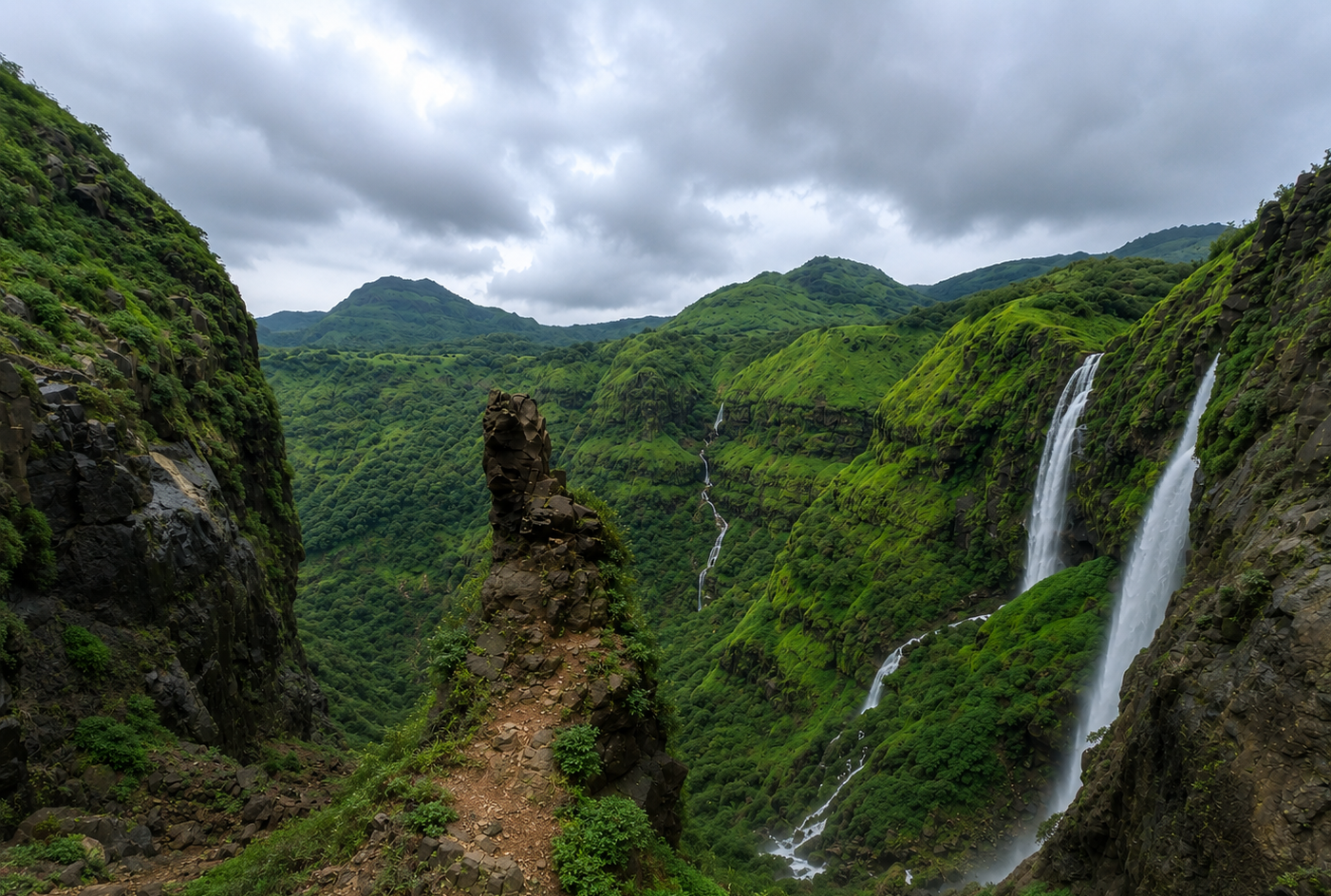
The Sahyadris come alive during the monsoon. The hills turn green, streams start flowing, clouds settle over the forts and trails, and places that look dry for most of the year can feel completely different.
But monsoon also changes the way you trek.
A trail that feels simple in summer can become slippery, muddy, confusing or difficult to cross during heavy rain. If this is your first monsoon trek, choosing the right trail and preparing for the conditions is more important than simply choosing a popular destination.
This guide will help you plan your first monsoon trek, from choosing the right route and people to go with, to checking the weather, packing your bag and knowing when it is better to turn back.
01. Start With Yourself
Before choosing a trek, think about your own experience and comfort.
Ask yourself:
- How much walking do I normally do?
- Have I walked on uneven or rocky trails before?
- Am I comfortable walking in rain?
- How do I feel about steep climbs and descents?
- Am I comfortable around heights?
- Have I used a map or navigation app before?
- Am I comfortable walking for several hours?
You do not need to be extremely fit to start trekking. But your first trek should match your current ability.
Do not choose a trek only because someone told you it was easy.
Easy for someone else may not be easy for you.
02. Which Trek Should You Choose?
There is no single best first monsoon trek in the Sahyadris.
The right choice depends on your fitness, experience, route and the conditions on the day.
For a first trek, look for a route with a manageable distance, reasonable elevation gain, a well established trail, limited exposure and straightforward navigation.
If possible, avoid making your first monsoon trek one that involves difficult rock sections, technical climbing, narrow exposed traverses or potentially dangerous water crossings.
Look beyond the difficulty rating
When researching a trek, check:
Distance
Elevation gain
Terrain
Exposure
Water crossings
Navigation
Weather sensitivity
Transport and exit options
A trek marked as easy on a website may feel very different after several hours of rain.
The route also matters. Two different routes to the same destination can have very different levels of difficulty.
A simple approach for beginners
Start with a manageable route.
Get comfortable with walking in rain, slippery terrain and changing conditions.
Then gradually move towards longer and more demanding treks.
03. One Day or Two Days?
For your first monsoon trek, a one day trek is usually easier to manage.
You have less equipment to carry, fewer logistics to plan and no overnight arrangements to worry about. It is also easier to return if the weather changes or someone in the group is struggling.
A two day trek can be a great experience if you are already comfortable with longer walks, carrying a heavier backpack and staying outdoors overnight.
Do not choose a two day trek simply because camping sounds exciting.
For most beginners, starting with a manageable one day trek is a good way to understand how they feel on the trail.
04. Who Should You Go With?
The people you go with can make a big difference, especially on your first monsoon trek.
Friends
Going with friends is perfectly fine if someone in the group understands the route and everyone is prepared for the conditions.
Just because someone has completed many treks does not automatically mean they know how to handle every monsoon situation.
An experienced trekker
Going with someone who knows the route, understands the terrain and can make sensible decisions can be very useful.
A trekking organisation
If you do not have an experienced group of your own, joining an organisation can be a good option.
Before booking, understand who will lead the trek, the group size, route, emergency arrangements and what happens if the weather becomes unsafe.
A local guide
A local guide can be particularly useful on unfamiliar routes, especially where navigation is difficult or several trails exist.
Going alone
For your first monsoon trek, it is better not to go alone, particularly on an unfamiliar route.
Having someone with you means there is another person who can help with navigation, decision making or an unexpected problem.
05. Check the Weather Before You Leave
Do not check the weather only when you wake up on the morning of your trek.
Check it a few days before, again the day before and once more before leaving.
Look at:
- Rain forecast
- Heavy rainfall warnings
- Thunderstorms and lightning
- Wind
- Visibility
- Weather around the trekking area
- Conditions on the approach road
Also check whether there are any local restrictions or warnings for the particular area.
If the weather looks unsafe, postponing the trek is a better decision than trying to make the original plan work at any cost.
The mountains will still be there.
06. Rain at Your Location Is Not the Whole Story
This is especially important when your route involves streams, waterfalls or valleys.
It may not be raining heavily where you are standing, but heavy rain somewhere higher up can increase the water level downstream.
This is why you should be extra careful around:
- Streams
- Rivers
- Waterfalls
- Gorges
- Narrow valleys
Never assume that a water crossing is safe simply because it looked fine in an older photograph or someone crossed it earlier.
07. Be Careful Around Water
Water is one of the biggest things that can change during a monsoon trek.
A stream that looks shallow can have a strong current. Rocks under the water may be slippery, uneven or difficult to see.
If the water is deep, fast flowing, rising or difficult to judge, do not cross.
Do not cross just because the rest of the group is doing it.
Do not take unnecessary risks because you have already travelled a long distance.
And never enter strong flowing water just to get a photograph.
Sometimes the safest decision is simply to turn around.
08. Waterfalls Are Beautiful. Keep Your Distance.
Monsoon waterfalls are one of the biggest attractions of the Sahyadris, but they also need caution.
Avoid standing near edges, climbing wet rocks beside waterfalls or entering strong currents.
Rocks can become extremely slippery and water levels can change quickly.
You do not need to stand at the edge to enjoy a waterfall.
A safe viewpoint is a much better place for a photograph.
09. What Should You Carry?
There is no single packing list that works for every trek.
Your requirements depend on the weather, route, duration, terrain and your personal needs.
Essentials
Rain protection
Carry a poncho or suitable rain jacket.
Backpack protection
Use a rain cover and keep important items inside waterproof bags or liners.
Good footwear
Choose footwear suitable for the terrain with a reasonably good grip. Avoid worn out soles.
Water
Carry enough drinking water even if the route has water sources.
Food and snacks
Carry enough for the planned duration and a little extra.
Headlamp
Even on a one day trek. Delays happen.
Phone and offline map
Do not depend completely on mobile network.
Power bank
Useful for navigation and emergencies.
Basic first aid
Carry basic supplies suited to your group and route.
Personal medicines
Carry anything you normally need.
Identification and emergency information
Keep important details easily accessible
Useful Depending on the Trek
Trekking poles
Helpful on slippery and uneven trails.
Extra clothing
Useful when you expect prolonged rain or a long day outdoors.
Quick dry clothing
Generally more comfortable than cotton when wet.
Dry bags or waterproof pouches
Useful for electronics, documents and spare clothes.
Leech protection
Useful on wet forest trails during the monsoon.
You do not need to buy everything before your first trek. Understand the route first and carry what the conditions actually require.
10. Protect Your Phone and Electronics
Your phone may be your map, camera and communication device during the trek.
A backpack rain cover alone may not be enough.
Keep your phone, power bank, documents and other electronics inside additional waterproof protection.
Before leaving, download your route for offline use.
Do not assume that mobile network will be available throughout the trail.
11. Start Early and Decide When You Will Turn Back
A monsoon trek can take longer than expected.
Mud slows you down. Rain reduces visibility. Slippery sections need more attention. Waiting at a difficult section can also add considerable time.
Plan your:
Start time
Expected walking time
Breaks
Turnaround time
Descent
Transport
A turnaround time is particularly useful.
For example: If we have not reached this point by this time, we turn back.
This prevents the common mistake of continuing simply because you have already come a long way.
Reaching the top is not more important than returning safely.
12. Walk Differently in the Monsoon
Wet trails require a little more patience.
Slow down.
Look at where you are placing your feet instead of simply following the person ahead.
Be particularly careful on:
- Wet rocks
- Mud
- Moss covered surfaces
- Steep descents
- Fort steps
- Ladders
- Exposed sections
Keep some distance between people so that one person’s slip does not affect the person behind them.
Trekking poles can help with balance, but they cannot replace careful footing.
13. Navigation Becomes More Important
A trail can look very different during the monsoon.
Grass can cover the path. Fog can reduce visibility. Water can create what looks like a new route. Multiple small trails can appear.
Before starting:
- Download the route offline.
- Study it before the trek.
- Identify important turns and landmarks.
- Know where the route starts and where it ends.
- Check your location periodically.
- Do not blindly follow another group.
If you realise that you are lost, stop and reassess.
Continuing deeper into an unfamiliar trail rarely makes the situation better.
14. Tell Someone About Your Plan
Even if you are trekking with friends, tell someone who is not part of the group about your plan.
Share:
- Trek and route
- Starting point
- Expected return time
- Names of people in the group
- Contact details of the person leading
- Emergency contact information
If the plan changes significantly, let them know.
It is a simple step that can make a difference when something does not go as expected.
15. Know When Not to Go
Sometimes the best trek plan is to postpone it.
Consider changing your plan if:
- There is a serious weather warning
- Heavy rain is expected around the route
- Water levels are already high
- The route has known flood or landslide concerns
- Access has been restricted
- Transport is affected
- Your group does not have the experience required
- Someone in the group is unwell or unprepared
There is nothing wrong with cancelling a trek because conditions are not suitable.
Knowing when not to go is also part of becoming a better trekker.
16. Your Simple Pre Trek Checklist
Before leaving home, take a few minutes to check these.
Route
✓ Do I know the route?
✓ Do I understand the difficulty and terrain?
✓ Do I know the important sections?
Weather
✓ Did I check the latest forecast?
✓ Are there any warnings?
✓ Could rain affect streams or crossings?
Group
✓ Am I going with people I can rely on?
✓ Does someone understand the route?
✓ Does someone know basic first aid?
Equipment
✓ Rain protection
✓ Suitable footwear
✓ Water and food
✓ Headlamp
✓ First aid
✓ Offline map
✓ Power bank
✓ Waterproof protection
✓ Personal medicines
Plan
✓ Start time decided
✓ Turnaround time decided
✓ Transport planned
✓ Emergency contact informed
✓ Backup plan considered
If several of these are still unanswered, take some more time before starting.
What Makes a Good First Monsoon Trek?
Do not choose your first trek only because it is famous or looks beautiful on Instagram.
A good first trek is one where:
i. The difficulty matches your ability.
ii. The route suits the weather.
iii. The people you are with can handle the situation.
iv. Your equipment is suitable for the conditions.
v. You have enough time to complete the route safely.
vi. And you know when to turn back.
That is much more useful than simply choosing the most popular fort or waterfall.
Final Thoughts
The monsoon is a wonderful time to explore the Sahyadris. The landscape changes completely and even familiar trails can feel new.
But the rain also demands a little more preparation.
You do not need years of experience or expensive equipment to begin. Start with a route that suits you, understand the conditions, go with the right people and learn to make sensible decisions on the trail.
Your first trek does not need to be the hardest one.
It just needs to be a good place to begin.
The goal is not simply to reach the top. It is to learn enough to come back safely, enjoy the experience and be ready for the next trail.
Start small. Learn as you go. Let your experience grow with every trek.